
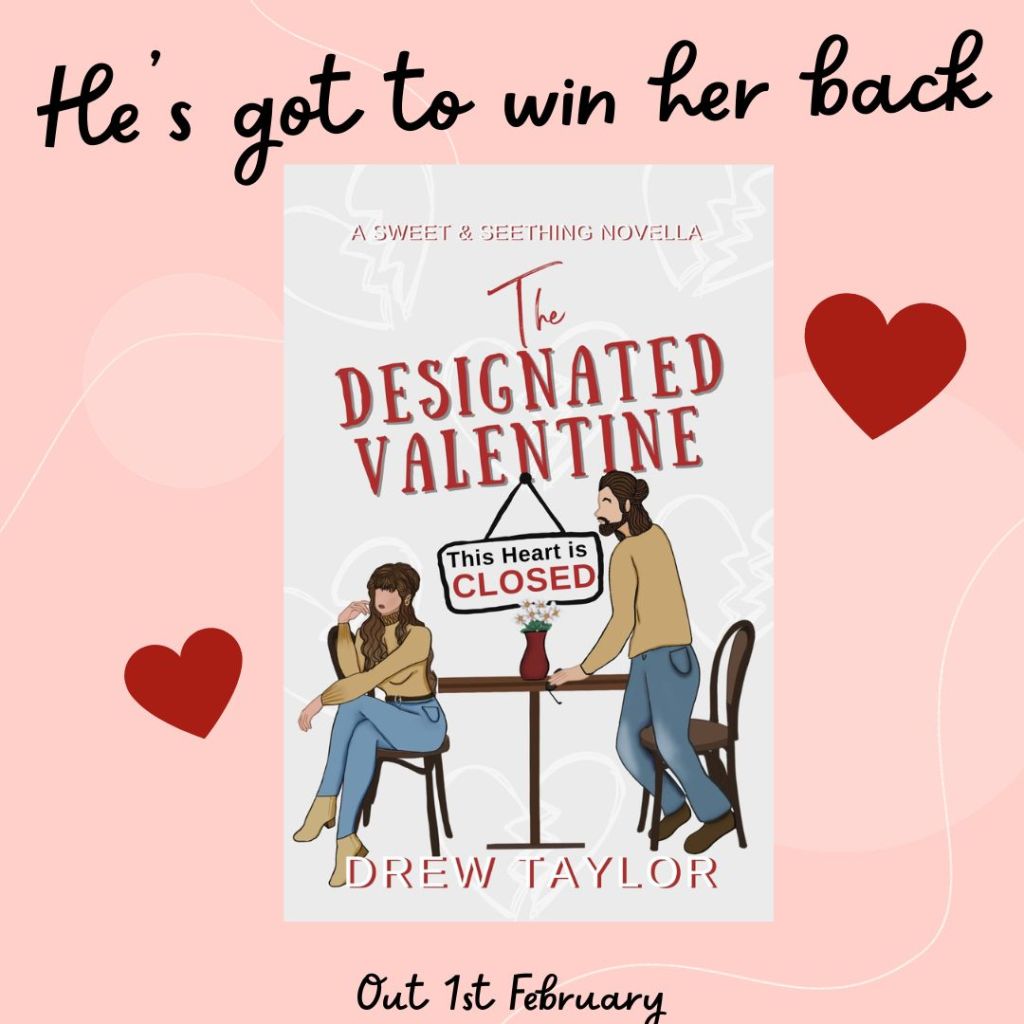
Drew Taylor is a US based writer of contemporary romance, and I recently had the privilege of being on her ARC team for ‘The Designated Valentine‘. More about that later! But first, let’s find out a bit more about Drew.
Drew, welcome! You’ve published a number of books, so can you share a little bit of your journey with writing? Is it something you’ve always done?
Hi, Sophie! I’m delighted to participate in this interview; thank you so much for asking me. I wouldn’t say writing has always been a part of my existence, but storytelling has. I grew up in a household that fostered my love of reading. My parents read to me, they allowed me to read on my own, and then, when I entered Kindergarten, I was the only one in my class who could read fluently enough to read stories to the class. Stories I read (and watched) began to root in my mind, and I found myself acting them out or creating a whole new storyline in my mind—I do believe we call this fan-fiction, now, ha—all while forcing my parents and siblings to play make-believe with me. My earliest memories of writing involve flexing my lyrical prowess (and that is a total joke). I enjoyed writing songs and poems and journalling. In middle school I began writing short stories. It started as school assignments that I put way too much effort into, but it paid off. My teachers loved my writing, and they encouraged me to continue. However, during high school, I stopped. Sports and grades ruled my life, and I barely had time to read for fun, much less write for fun. College remained the same; I was so focused on reading and writing for my degree that I didn’t have time to do it for pleasure. That all changed when I met a girl named Whitney. She began working at the boutique I was managing, and she started telling me about this book she was writing. We instantly bonded, and I told her that I had a story idea that had been on hold for a long while. She encouraged me to start writing it, and so I did. That story never ended up past fifteen pages, but the idea of writing a novel was now in my head.
As the next couple of years passed, and I graduated, I began teaching history and occasionally dabbling in a dystopian story I’d dreamt up (thanks to Nadine Brandes and her Out of Time series). Then, the pandemic hit, and I couldn’t stomach writing about controlling governments due to the fact I was living in the midst of one. It no longer felt like fiction. So, I turned to reading romantic comedies, which is something I had never really enjoyed or read in the past. I actually, up until that point, did not like any contemporary novels. I ended up creating a bookstagram and my world was opened up. I’m not sure how I ended up following who I did, but I came across Leah Brunner, read her novel Running Mate (which had a different title at the time), and then noticed how she wrote the book simply because she knew she could. That inspired me greatly, so I set out to write a fun, light-hearted novel, which ended up becoming my first published contemporary romance, The Politics of Christmas. I wanted to write clean fiction, like all these other authors I had come to love (Emma St. Clair and Leah Brunner being the top two at the time), but I needed more in my novels. I needed Christ. Yes, they wrote clean fiction, but they didn’t write characters who were openly Christian. I wanted that. I wanted a book that didn’t fit the mould of Christian Fiction (because everytime I read one, I was so turned off by the perfect characters because ya girl is soooo far from pure and perfect) but was still written from my Christian worldview. But I will pause that train of thought there because that is the next question 🙂 When I began writing TPOC, I didn’t have plans for more. I thought this was a one-time thing to do during the pandemic. Alas, the writing bug bit me hard and now I don’t think I could stop writing if I broke both my hands (yay for voice transcriptions!).
I love that you have such a clear vision about being a Christian who writes from that perspective, but not necessarily books that would be categorised as ‘Christian fiction’. Did that clarity develop over time? I’d love to know how you found your niche, as it were.
Wow, so yeah. I love that you think my vision is clear! I often think it’s muddied waters I’m constantly wading through. It’s nuanced, to say the least, especially when you have to constantly explain yourself, and even then, some people won’t pick up your book because it isn’t labeled Christian Fiction (even if your book has more Christianity in it then many CF-published books). The starting goal of writing books that had openly Christian characters but Christianity wasn’t the overarching theme or plot in the story has not changed, but other ideas and goals have developed overtime as I’ve learned the industry, began taking publishing seriously as a potential full-time career, and have communicated with my readers. Publishing TPOC allowed me to realize that there were so many other readers out there starving for real stories that involved real sinners who turned to a real God. I had only seen a handful of romantic comedies that were “Christian,” and I wanted to find a place and platform in that market. Books seemed to be either/or…either overtly Christian and the characters felt too good for me (again, for me. I know it’s needed. This is not me being anti-CF. I know there are so many Christians out there who relate more to those characters) or the books were clean/closed-door without even the mentioning of God. I wanted something in-between. I wasn’t strictly a “good girl” or “bad girl” by any means; I daily strived to live for Christ (even as I often failed). I wanted to read characters like that. I wanted to explore how they turned to Christ, how they viewed Christ, and how they handled forgiveness, redemption, and the free gift of grace. That’s still my goal as an author even as I transition from writing contemporary to dystopian, which is what I’ve always felt called to.
Now tell us about the Designated series. What was the inspiration behind it?
I began writing the first book, The Designated Friend, while my first novel, TPOC, was in edits. I was supposed to be writing the second book in The Politics of… series, but Braxton and Hadley demanded that their story be told. At that time, I was reminiscing on my life and how I constantly questioned the Bible and what I was taught in church (people didn’t like that in the Bible Belt), and I wanted to write a character who wasn’t a believer because she saw what I saw in the Bible Belt: a slew of people who identified as Christians but did not walk out that faith they claimed to have. The natural counter to her high-energy, skeptical, outspoken character was a quieter, strong, faith-filled man. While I wrote Hadley as a way to wrestle with my past when it came to questioning my beliefs, I wrote Braxton as the man I wished could have walked beside me as I did. I wrote him as the “perfect” man that I would love to marry someday. It’s sufficient to say this story was fun and entertaining and a joy to write, even the darker parts. The second book was never meant to be The Designated Valentine. That book was never supposed to exist. However, after I moved to Alaska (as I had wrapped up the first draft of TDF), I entered into my first relationship after five years of singleness. Ultimately, I was not pursued in a Christ-like manner, and I was carrying the pain of that as I broke up with him even though I had completely chosen to love him. To cope, I wrote The Designated Valentine. I wrote the entire book in a month, which is something I’ve never even come close to doing before. That book feels like a journal to me. More so than any other book I’ve written though each one contains pieces of me and my life and my experiences. The next book releasing, The Designated Twin, has simply been a lot of fun to write (royals in Mississippi, hello. Lots of fun!). The Designated Date, the last book, will be my most personal book to date. I’ve already drafted quite a bit of it, and it’s going to shake up the Christian rom-com world. I haven’t seen another book like it before. Finally, my brother would murder me if I didn’t credit him with the series title of Designated. He once was complaining that he was always the designated date to girls, and well, I ran with the concept! Thanks, bro.
I loved ‘The Designated Valentine’. The chemistry between Karoline and Mason was strong, but with boundaries. How do you find walking that line, as a Christian writer? Do you find it easier now that you have a lot of books under your belt?
Thank you so much for reading and loving TDV, first of all. It’s my favorite one I’ve written to date. Hmm, boundaries. Such a strong word. A subjective word. The easiest way for me to walk the line is to follow the characters. Every character has different boundaries and acceptable levels of physical contact and lustful thoughts that they can manage, just like us in real life. It’s easy to simply follow their patterns. When I write characters who aren’t Christian, I make a point to adhere to classic closed-door and Level Two heat standards (as promoted by Rachel with Closed Door Romance on Instagram) since their personal character boundaries may reside in the open-door realm. I don’t know if it’s easier now that I have four books under my belt, but I can say that I am more comfortable writing what I personally feel convicted over and not caring too much about what others perceive as right and wrong. Some readers may think Karoline and Mason were too much while others believe there wasn’t enough chemistry. You can’t please and protect everyone, so as an author, the best I can do is follow my own personal convictions and please the Lord first and foremost. He gave us beauty, physical contact, desire, and romance. Those aren’t bad things and shouldn’t be villainized in the Christian world.
Mason was a hero with a past. What, for you, are the most important qualities for a male lead character?
To say that I wish to write every male character as perfect envisions of what I want in a man is an understatement. I struggle making my male leads flawed. If you read any of my other books, you’ll notice that the male leads get away with a lot more than my females do. I think it’s mostly because I am a woman author, but I also think it’s because I am such a flawed individual myself. When it came to Mason’s character, I based a lot of what he did and said off why my ex did and said to me, so it was easy to make him the villain of the story. TDV is unique in that capacity. TDD’s male lead, Stone Harper, will follow a very similar pattern, just in a different context. Overall, I think it’s important for male leads to be shown as a capable leader. I am a believer in male headship in the confines of marriage, and I think it’s important for men to show that he is capable of leading and pursuing while dating. (Which was Mason’s huge flaw… he didn’t pursue the woman he loved until it was almost too late.)
Which authors inspire you? Do you have a favourite book you return to?
Hmm, strictly closed-door rom-com authors that inspire me are Emma St. Clair, Camilla Evergreen, Leah Brunner, Kortney Keisel, Julie Christianson, Marie Soleil, and Cindy Steele. Latisha Sexton and Dulcie Dameron are also two rom-com authors who inspire me who also write from a Christian perspective. Outside of rom-com, I’m inspired by Nadine Brandes, Francine Rivers, KM Shea, Rachel E. Scott, Victoria McCombs, Stephanie Garber, and Tabitha Caplinger. My favorite deceased authors are Jane Austen, Charlotte Bronte, and George Orwell. I’ve probably missed some favorites, but these are the ones that immediately come to mind. Some favorite books that I’ve read multiple times are Emma by Jane Austen, Faking Christmas by Cindy Steele, The Twilight Saga by Stephenie Meyer, The Hunger Games trilogy by Suzanne Collins, the Harry Potter series by J.K. Rowling, and all of Camilla Evergreen‘s books… (seriously, these are amazing. It’s not a Christian perspective, but it is a neurodivergent perspective.)
I saw that you’re an English teacher—me too! What is your favourite book to teach?
Yes, I teach World Literature at the 10th grade level! However, I’ve realized I don’t quite enjoy teaching reading and writing, ha. I would much rather teach history again (fingers crossed that I will get to soon). I do enjoy teaching The Joy Luck Club by Amy Tan. I also love teaching Anthem by Ayn Rand! These books have powerful themes and lessons that my 10th graders quite enjoy learning and engaging with.
You live in Alaska—what’s that like? It just looks like such a unique, beautiful place.
It’s cold. Haha, but seriously… I adore this land. I moved here in July of 2022, and I have no regrets. I miss Mississippi and the warmth and my family and friends, but the community I’m building here is wonderful. I love the seventy degree summers that allow for lovely hikes and fishing. I love the snowy winters that create a frosted beauty and allow for a season where I’m forced to slow down (and ski. I love skiing). I love that for the summer, I have constant sun and daylight. I do not like the constant darkness during the winter and have found that I suffer from seasonal depression, but it’s worth the trade off for the rest of the year.
What are you excited for this year?
I am excited to finish the Designated series and start throwing myself into publishing my Christian dystopian romance. This story has been on my heart for four years, and I am thrilled the Lord has told me to continue it. I’m also excited to see where He leads my authoring career, teaching career, and new friendships that I’ve developed over the past couple of years. And as always, I’m still praying that He will lead me to a God-fearing man that I can spend the rest of my life with.
You can follow Drew on Instagram @authordrewtaylor. The Designated series is out now!
As an Amazon Associate, I earn from qualifying purchases.
 Sophie Toovey
One thought on “Author Interview: Drew Taylor”